Moving a Kleemann MR 130: What Goes Into Transporting a Mobile Impact Crusher
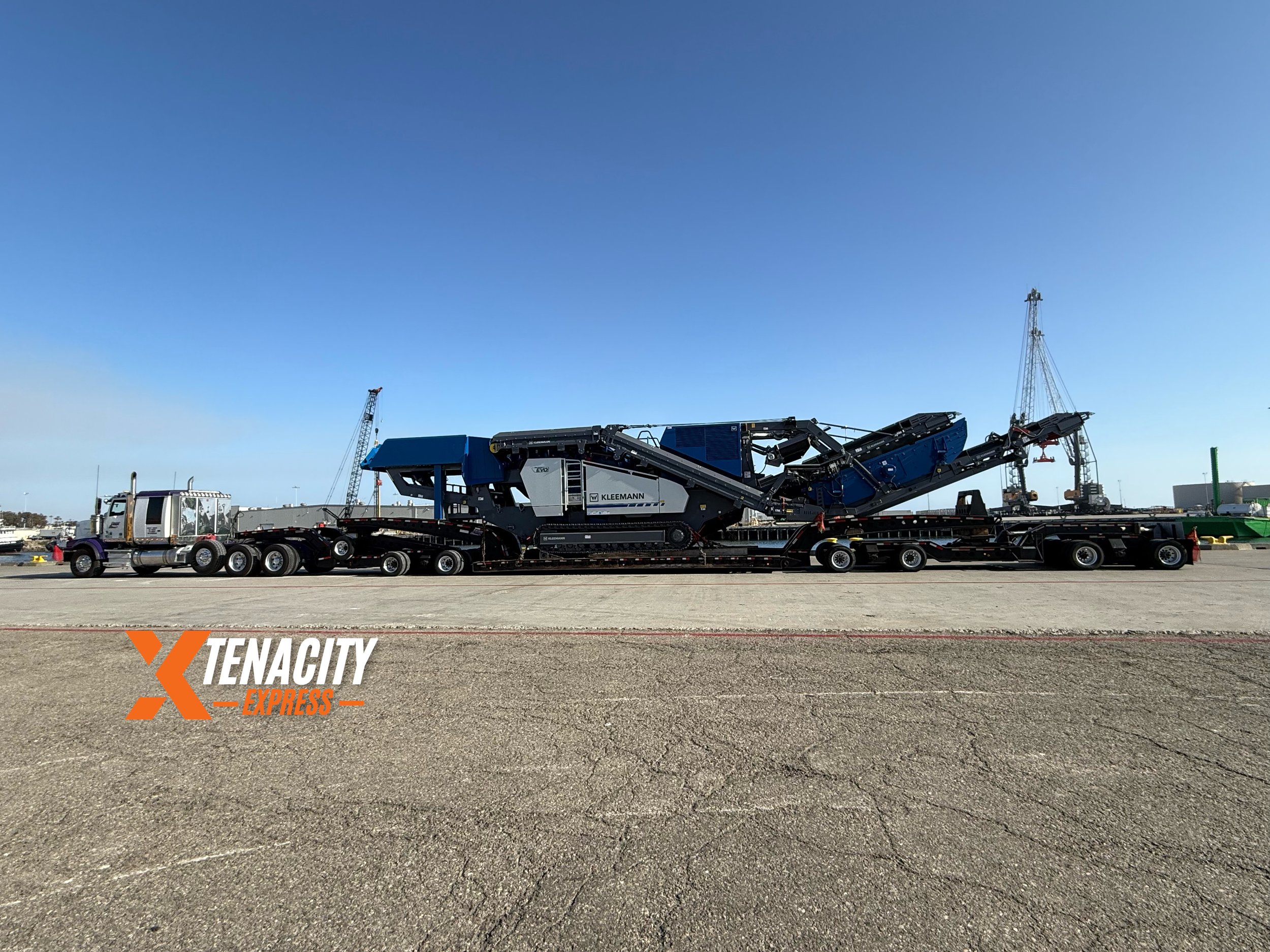
Moving heavy equipment from a port comes with a different set of challenges than a standard point-to-point shipment.
For this project, we were tasked with transporting a Kleemann MOBIREX MR 130 mobile impact crusher after it arrived via RoRo vessel at Port Hueneme, California.
The machine may be designed to move under its own power around a jobsite, but getting something of this size from the port and onto the highway is an entirely different operation.
Before the truck ever arrives, several pieces have to come together: understanding the equipment, selecting the right trailer configuration, coordinating the port pickup, planning the permitted route, and making sure the machine can be safely loaded and transported.
For this move, that planning started before the MR 130 ever rolled off the vessel.
Understanding the Equipment
The first step in moving a machine of this size is understanding exactly what you're dealing with.
The Kleemann MOBIREX MR 130 is a mobile impact crusher built to process large volumes of material on demanding jobsites. That capability comes with a transportation challenge—the machine is massive, heavy, and, most importantly, long.
For this move, we utilized a 9-axle heavy-haul configuration to safely distribute the weight of the machine across the combination.
But weight was only part of the equation.
One of the biggest challenges with transporting the MR 130 is its overall length and loading geometry. Getting a machine of this size onto a trailer requires more than simply having enough capacity on paper. Usable deck space, approach angle, ground clearance and final positioning all have to be considered before loading begins.
With a tracked crusher, you're putting an enormous amount of concentrated weight onto the trailer as the machine climbs onto the deck. Once loaded, its position becomes critical. A few feet in either direction can significantly change how that weight is distributed across the tractor, trailer and axle groups.
The goal isn't simply to get the machine on the trailer.
It's to get it loaded in a position where the entire combination can safely travel down the highway.
Coordinating the RoRo Port Pickup
This shipment started at Port Hueneme, where the MR 130 arrived via RoRo—or roll-on/roll-off—vessel.
RoRo shipping allows large wheeled and tracked equipment to be driven onto and off specialized vessels instead of being loaded into containers. It's an effective way to move oversized machinery internationally, but once the equipment reaches the United States, the next phase of transportation has to be ready.
A heavy-haul port pickup requires coordination between several parties. The equipment has to be released and available, the truck and driver need the appropriate port access, and the transportation equipment needs to arrive prepared for the machine being picked up.
When you're sending a 9-axle combination into a port, mistakes get expensive quickly.
Sending the wrong trailer or discovering a problem with the machine's dimensions after the truck arrives can mean delays, additional port costs and an entirely new transportation plan.
That's why confirming the equipment and planning the move beforehand is such an important part of the process.
Loading the MR 130
Loading was one of the most important parts of this move.
A mobile crusher isn't something you simply drive onto a trailer and strap down.
The sheer size and weight of the MR 130 means the loading process has to be controlled from the beginning. The trailer needs to be positioned correctly, the loading surface has to support the operation, and the machine has to approach the trailer at an angle it can safely climb.
Then comes positioning.
Once the tracks reach the deck, the driver has to get a machine weighing tens of thousands of pounds positioned correctly across the trailer's axle groups.
Too far forward and you can overload the tractor or forward axle groups.
Too far back and you create a different weight-distribution problem.
Getting that balance right is one of the reasons experienced heavy-haul operators are so important on moves of this size.
Preparing for the Road
Once loaded, the project transitions from a loading challenge to a highway transportation challenge.
Heavy-haul moves have to be planned around the entire loaded combination, not simply the dimensions of the machine itself.
Trailer height, deck configuration, axle spacing and equipment positioning can all affect the final transportation dimensions.
Those dimensions ultimately determine the permitting and routing requirements for the move.
The route that works for a standard truck isn't automatically the route that works for a 9-axle combination carrying an oversized crusher. Bridges, turns, construction, roadway restrictions and other obstacles can influence how the shipment gets from origin to destination.
This is why heavy-haul transportation is often won or lost during the planning stage.
By the time the truck starts moving, most of the important decisions should already have been made.
More Than Finding a Truck
Projects like this are a good example of why transporting heavy equipment is about more than finding an available truck.
The truck is only one piece.
You have to understand the equipment being transported, determine the appropriate trailer configuration, coordinate the pickup, understand how the machine will load, account for its weight distribution, obtain the necessary permits and build a route that works for the loaded combination.
When everything is planned correctly, something that looks extremely complicated becomes surprisingly straightforward.
A Kleemann MR 130 arrived at Port Hueneme aboard a RoRo vessel.
A 9-axle heavy-haul combination was positioned to receive it.
The machine was loaded, secured and prepared for permitted highway transportation.
And another piece of heavy equipment was on its way to where it needed to go.
That's the part of transportation most people never see—and the part that makes these projects interesting.